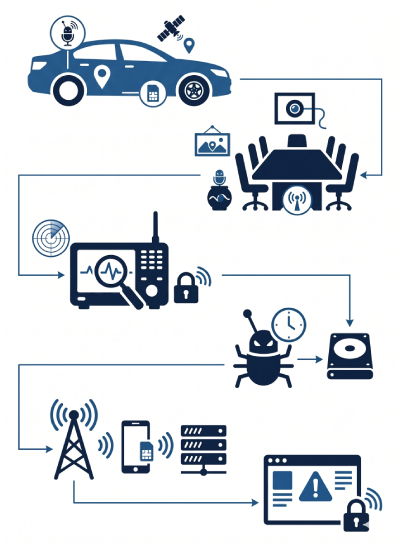
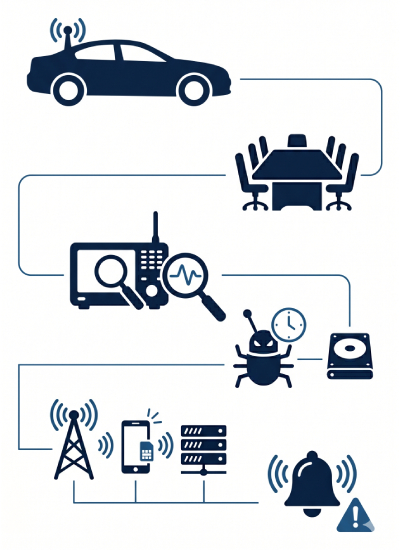
Why is dormant bug detection important? ─ Because the most sophisticated surveillance devices are often those that transmit the least. By masquerading as legitimate cellular and IoT devices, they blend seamlessly into everyday network traffic, making them exceptionally difficult to detect.
Silent and Dormant Bug Detection Is Critical
Similar to modern cellular GPS trackers, surveillance devices such as eavesdropping bugs and covert cameras often employ advanced techniques to minimize their RF footprint. Rather than transmitting continuously, these devices are designed to remain silent for extended periods and may:
Collect information locally and silently
Remain dormant for days or weeks
Wake briefly to establish a cellular connection
Upload stored intelligence via a cellular connection
Immediately return to silent recording sleep mode
So basically continuous operation does not mean continuous transmission.
Continuous Operation vs Continuous Transmission
Some devices may transmit for only a few seconds per day. Others may communicate exclusively under specific conditions, such as:
During nighttime hours
On weekends
Outside business hours
When motion is detected
When sound is detected
Upon remote activation
This intermittent behavior significantly reduces the probability of detection during conventional bug sweeps and periodic inspections.