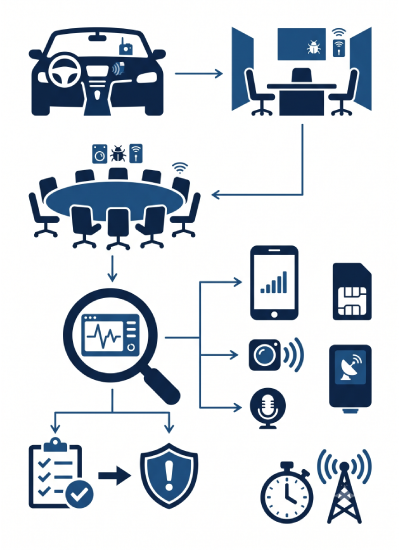
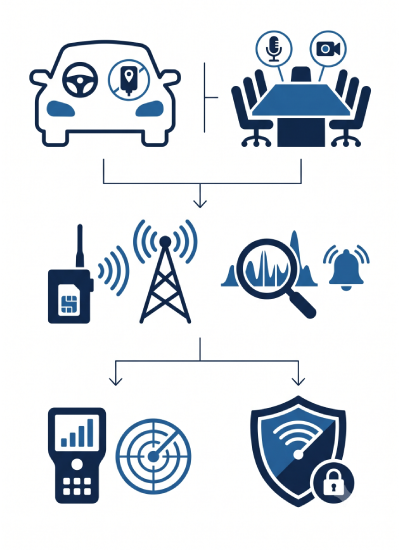
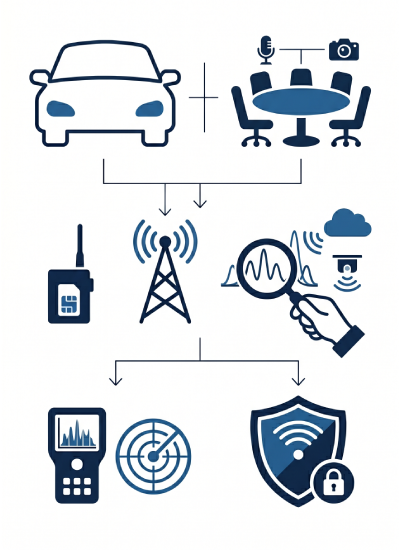
For 2G GSM, 4G LTE, and 5G-ready environments, the goal is not merely: “Detect cellular signals.”
The goal is to detect, classify, identify, and inventory all cellular transmitters, enabling operators to distinguish legitimate systems from unauthorized surveillance devices.
Identifying GPS Trackers
GPS Trackers are designed to blend in the regular 4G LTE or 2G GSM frequency range, similar to:
SIM or eSIM
eCall module
Telematics control unit
Infotainment modem
Vehicle diagnostics modem
2G GSM or 4G LTE modem
Fleet management system
V2X communication equipment
Modern GPS trackers are essentially small cellular computers, and instead of transmitting continuously, they often:
Wake up periodically
Upload location data
Return to sleep mode
This significantly reduces their RF signature and makes them harder to detect during short inspections.
Identifying Audio Bugs
Cellular Audio Bugs Can Operate Remotely. Traditional RF bugs continuously transmitted audio.
Modern cellular bugs blend in regular 4G LTE or 2G GSM frequency range, and even can be silent recorders.
They can:
Remain dormant for days or weeks
Accept incoming calls
Trigger on voice activity
Upload recordings periodically
Stream audio over LTE data sessions
Truly disable the LTE baseband
To an RF inspector, the device may appear silent for most of the inspection period. The transmission may occur only briefly, making detection much more challenging.
Identifying Espionage Cameras
Spy Cameras Have Become Cellular IoT Devices, that blend in regular 4G LTE or 2G GSM frequency range, and therefore more difficult to identify.
Modern covert cameras often include:
LTE modem
Embedded SIM
Cloud streaming capability
Motion-triggered recording
Remote access applications
These devices operate more often on the blending in 2G GSM or 4G LTE networks, and no longer require local Wi-Fi or other rapid recognizable frequencies.
From an RF perspective, the device may appear very similar to countless legitimate LTE-connected IoT products.
Learn More about Bug Detect Systems
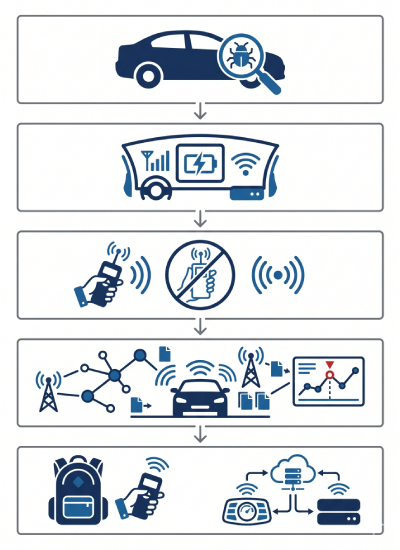
As tracking technology becomes increasingly sophisticated, covert devices are becoming more difficult to distinguish from legitimate connected-vehicle systems.
A hidden tracker may utilize the same cellular technologies, power-management techniques, and communication infrastructure as factory-installed automotive electronics.
Detecting these devices requires more than simply searching for RF transmissions. It requires visibility into the cellular device ecosystem operating around the vehicle and the ability to identify deviations from what is expected.