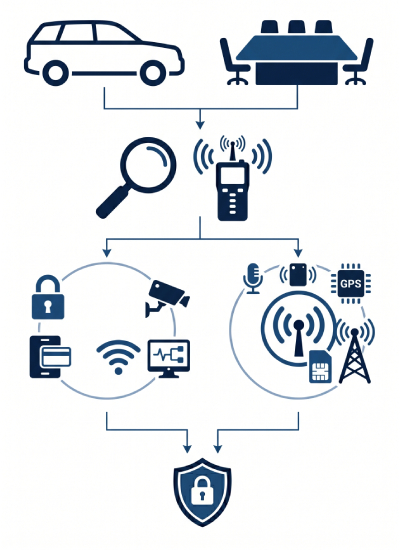
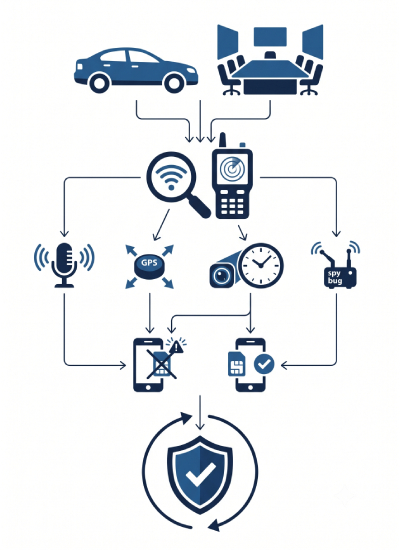
The surveillance threat landscape is evolving rapidly. Many modern surveillance devices are sophisticated embedded cellular systems that operate independently of local Wi-Fi, relay links, and traditional eavesdropping frequencies, blending seamlessly into 2G and 4G cellular networks.
Cellular Spy Audio & Video Bugs - vs - Trusted IoT Systems
The challenge is compounded by the increasing adoption of connected building technologies.
Corporate offices, boardrooms, government facilities, executive residences, and critical infrastructure sites frequently contain:
Smart HVAC systems
Building Management Systems (BMS)
Access control systems
Security and alarm panels
Smart locks
Environmental monitoring sensors
Cellular backup routers
Failover communication systems
Industrial IoT gateways
Utility monitoring equipment
Connected conference room technology
Remote facility management devices
Many of these legitimate systems utilize the same cellular technologies as modern surveillance devices.
Why Bug Detect is Crucial
Traditional Technical Surveillance Counter-Measures (TSCM) inspections often focus on detecting active radio transmissions, without determining whether the transmitting device is authorized or unauthorized.
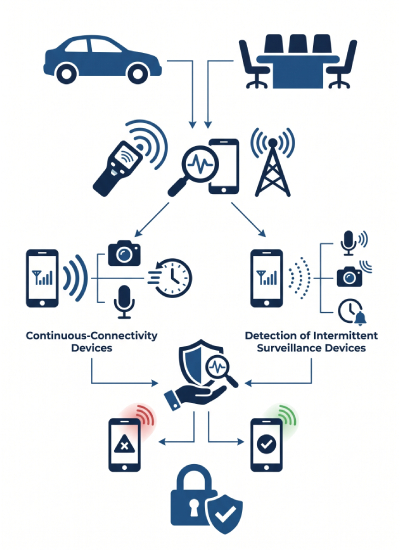
Continuous-Connectivity Devices
These devices may:
Maintain active LTE sessions
Stream audio or video continuously
Support live monitoring applications
Generate regular network activity
Because these systems produce ongoing cellular activity, they can often be identified rapidly.
Bug Detect can identify and classify cellular devices, enabling operators to distinguish authorized devices from potentially unauthorized surveillance devices.
Detection Intermittent Surveillance Devices
Not all surveillance devices communicate in the same way. Some maintain persistent network connectivity and regularly transmit data, while others are specifically engineered to minimize their cellular and RF footprint in order to reduce the likelihood of detection.
Rather than transmitting continuously, a device may:
Remain dormant for extended periods
Monitor audio continuously without transmitting
Activate only when sound exceeds a threshold
Upload recordings at scheduled intervals
Wake upon remote command
Transmit only when motion is detected
Upload video clips before returning to sleep mode
In some cases, a surveillance device may remain completely silent during an inspection while continuing to collect intelligence locally.