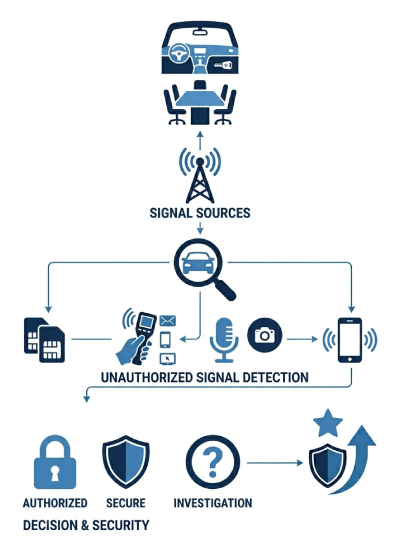
Vehicle GPS trackers increasingly operate on 2G GSM and 4G LTE networks, making them difficult to detect because they use the same frequencies as legitimate in-vehicle systems such as eCall, fleet management, and telematics.
– Bug Detect provides a solution to detect and identify these cellular GPS trackers.
How to differentiate Rogue GPS Trackers from regular GSM?
V2X (Vehicle-to-Everything) communication equipment
Embedded LTE and 5G connectivity platforms
The challenge is no longer simply detecting cellular activity.
The challenge is determining:
Which devices are expected
Which devices are authorized
Which devices are newly introduced
Which devices require further investigation
Trigger a GPS Tracker Identification
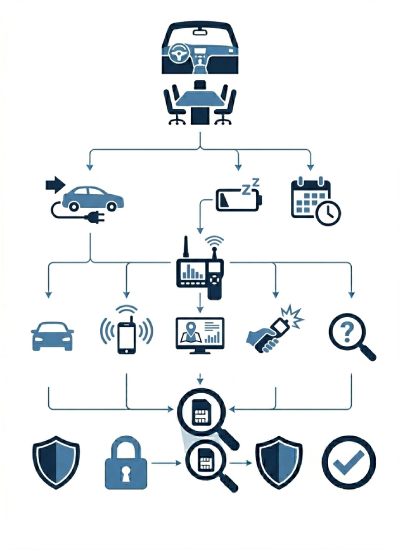
Traditional vehicle inspections rely on detecting active RF transmissions, an approach that is increasingly ineffective against modern cellular trackers. To extend battery life and reduce detection risk, many trackers employ aggressive power-management strategies.
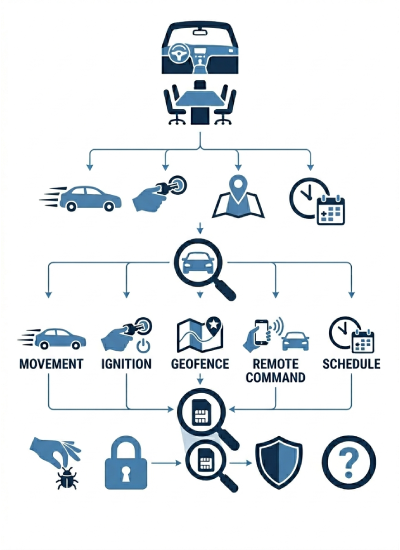
Others may only communicate when:
Vehicle movement is detected
An ignition event occurs
A geofence boundary is crossed
A remote command is received
A scheduled reporting interval is reached
As a result, a tracker can remain entirely undetected during a conventional short-duration inspection despite being fully operational.
GPS Tracker Detection ─ Continuous and Intermittent
Not all tracking devices behave the same way.
Which is why Bug Detect’s GPS Tracker Detection identifies both continuously transmitting trackers and low-duty-cycle (intermittent) devices designed to minimize detection by transmitting only at periodic intervals.